Emma contacted us with photos of the jewelry she was already selling, a list of new designs she wanted to test, and one important concern:
“How can I make sure the quality will remain consistent when I place a larger order?”
She owned a growing piercing studio and had previously purchased body jewelry from several suppliers. The prices looked attractive, and the first few pieces often appeared acceptable. But as her orders grew, problems began to emerge.
Some threaded tops did not fit the posts. Stone colors varied between shipments. A few pieces had rough edges around the setting. Product sizes were not always consistent, and material information was sometimes limited to the words “G23 titanium” without supporting documentation.

Emma did not simply need another catalog.
She needed a reliable titanium body jewelry manufacturer that could help her control material, specifications, threading, polishing and repeat-order consistency.
This is the story of how we developed her first ASTM F136 titanium body jewelry sample order—and what piercing studios, wholesalers and jewelry brands can learn from the process.
Why Was the Lowest Body Jewelry Price Not Necessarily the Best Deal?
Like most buyers, Emma initially compared suppliers by unit price.
That seems reasonable. However, the purchasing cost of wholesale piercing jewelry is not limited to the price shown on a quotation.
A lower unit price can become expensive when it results in:
- Threaded tops that cannot be used with existing posts
- Inconsistent bar lengths or gauges
- Loose stones
- Scratches or machining marks
- Poor surface polishing
- Incorrect colors
- Unclear material documentation
- Customer complaints and replacements
For a professional piercing studio, an unusable piece costs more than its purchase price. It also takes time to inspect, replace and explain the problem to the customer.
We therefore asked Emma to look at the total usable cost instead of comparing only the lowest quoted price.
The Cost Calculation Buyers Often Miss
Here is a simple example:
| Purchasing factor | Supplier A | Supplier B |
|---|---|---|
| Quoted unit price | Lower | Slightly higher |
| Thread compatibility | Not confirmed | Confirmed before production |
| Material documentation | “G23” description only | ASTM F136 documentation available |
| Surface inspection | Basic visual check | Multi-stage polishing and inspection |
| Specification consistency | Varies by shipment | Recorded by SKU |
| Expected usable quantity | Uncertain | More predictable |
Supplier A may appear cheaper on the quotation. But if part of the shipment cannot be sold or used, the actual cost per usable piece increases quickly.
A professional supplier should help the buyer understand where the price difference comes from—not simply offer the lowest number.
Does “G23 Titanium” Automatically Mean ASTM F136 Titanium?
This was one of Emma’s most important questions.
The term “G23 titanium” is widely used in the body jewelry market. However, buyers should not rely on a product description alone. They should confirm the exact material standard and ask whether supporting material documentation is available.
For professional piercing jewelry, ASTM F136 commonly refers to Ti-6Al-4V ELI titanium alloy intended for surgical implant applications.
The Association of Professional Piercers recommends looking for implant-certified titanium that complies with standards such as ASTM F136 or ISO 5832-3. It also emphasizes suitable surface finishing and smooth jewelry construction for initial piercings.
Material is the starting point, but it is not the entire quality standard.
An ASTM F136 titanium bar can still become a poor-quality piece of body jewelry if it has:
- Rough machining marks
- Scratches or burrs
- Poorly aligned threading
- Inaccurate dimensions
- Incomplete polishing
- An insecure stone setting
That is why we evaluate both material documentation and finished-product workmanship.
What Does Quality Mean in Titanium Body Jewelry Manufacturing?
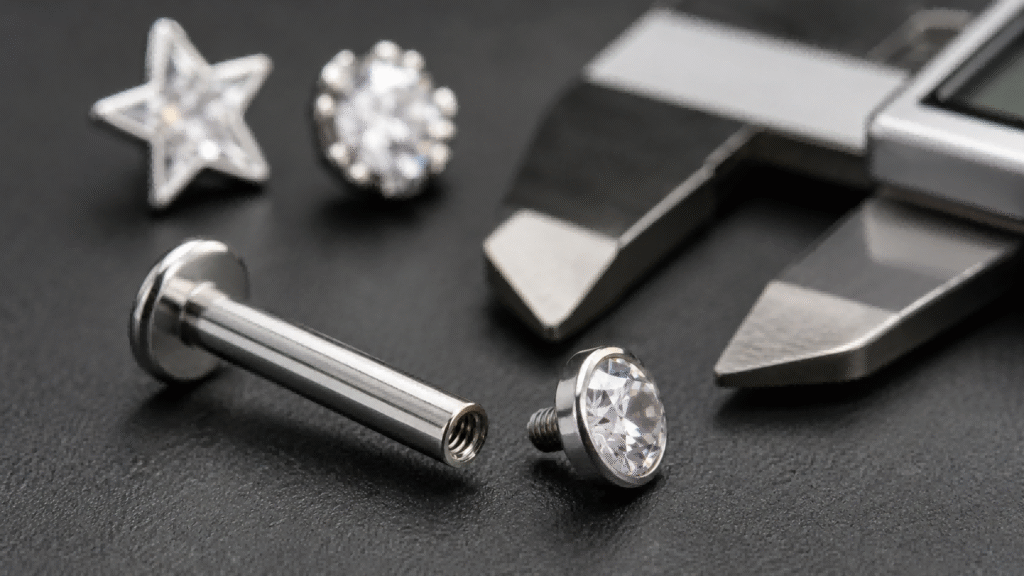
Before preparing Emma’s samples, we divided quality into five checkpoints.
Checkpoint 1: Material Documentation
The first step is confirming the titanium alloy used for production.
Buyers should ask:
- What is the exact titanium grade?
- Is it compliant with ASTM F136?
- Can the supplier provide relevant material documentation?
- Is the material traceable to the production batch?
A certificate alone does not inspect the finished jewelry, but it gives the buyer a stronger foundation than a general “titanium” description.
Checkpoint 2: Surface Polishing
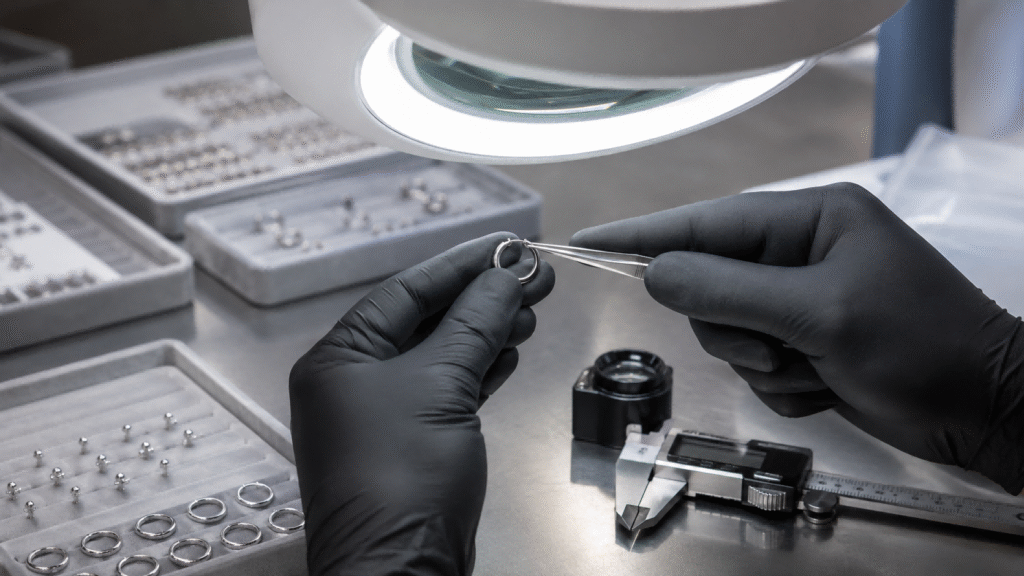
A well-polished piece should have a smooth, bright and consistent surface without visible scratches, burrs or polishing residue.
Mirror polishing is not only about appearance. Surface quality is especially important for jewelry intended for professional piercing applications.
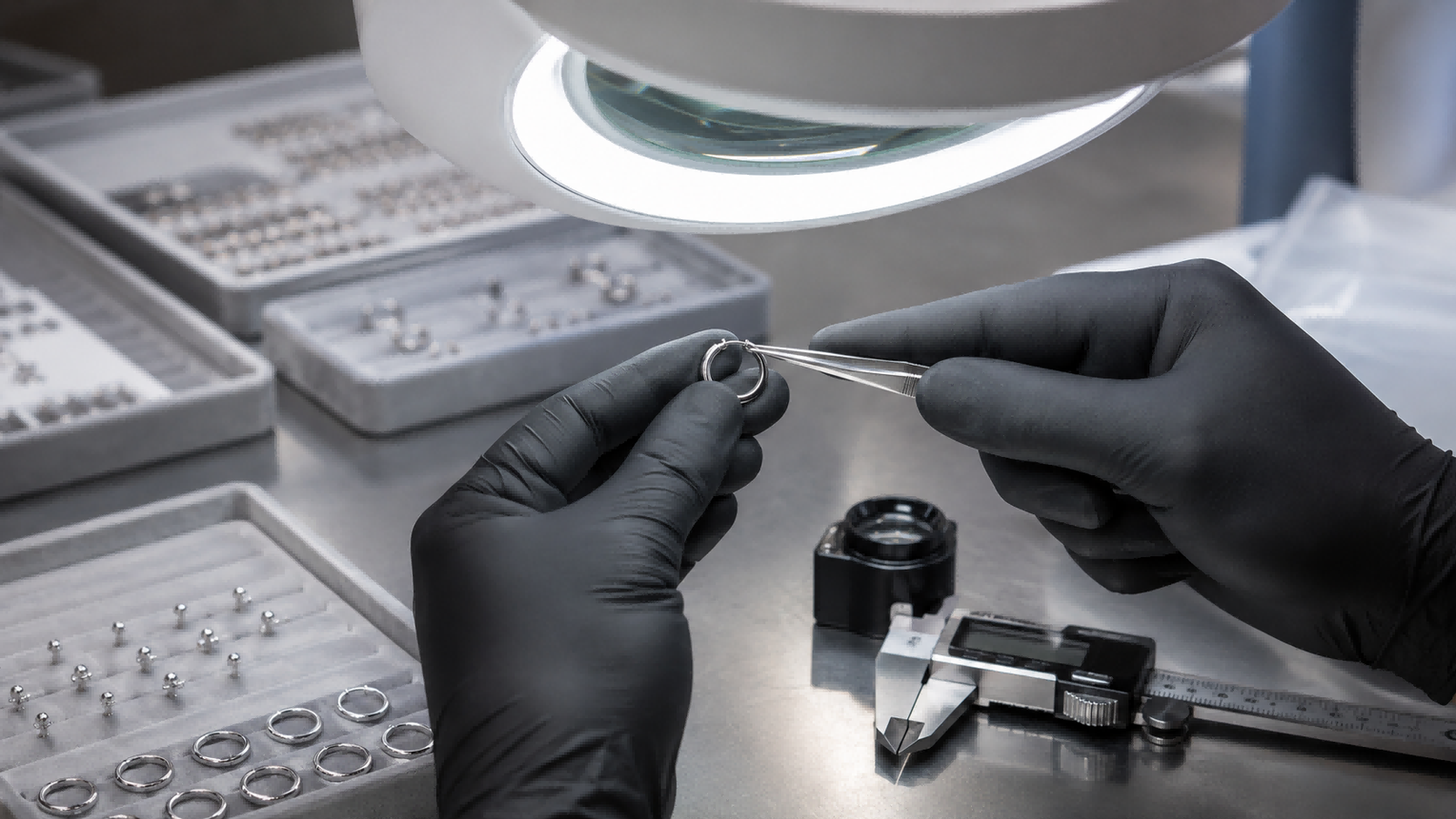
When Emma received the samples, we suggested checking them under magnification and strong directional lighting. This made it easier to see the areas around stone settings, thread openings and flat-back edges.
Checkpoint 3: Thread Accuracy
Thread compatibility is one of the most overlooked purchasing risks in internally threaded body jewelry.
Two products may both be described as 16G, but that does not automatically guarantee that every top will fit every post. The internal thread specification must also match.
Before placing an order, buyers should confirm:
- Gauge
- Thread size
- Post length
- Top size
- Whether tops and posts are sold together or separately
- Whether different collections use compatible threading
For Emma’s order, we created a clear specification list for the tops, labret posts and dermal bases she selected. This reduced the possibility of ordering visually similar but incompatible components.
Checkpoint 4: Stone Setting and Alignment
Decorative titanium body jewelry needs additional inspection.
For CZ, opal and other stone-set designs, we check:
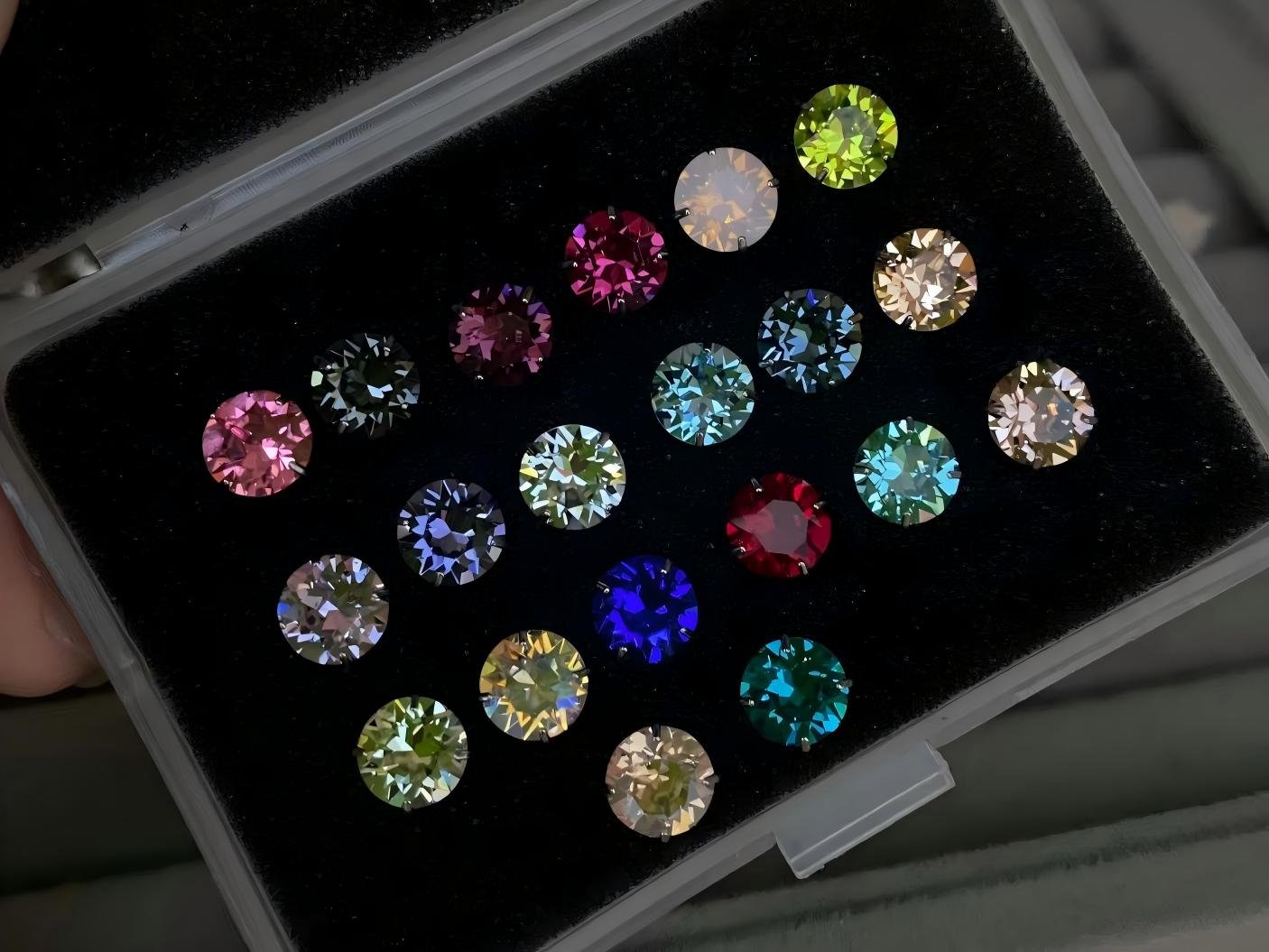
- Stone color
- Stone diameter
- Prong symmetry
- Stone security
- Center alignment
- Sharp or raised edges around the setting
A beautiful product photo cannot reveal whether a stone is properly secured. That is why physical sample testing remains important.
Checkpoint 5: Dimensional Consistency
A product may look correct while still having the wrong measurement.
Professional buyers should check:
- Bar gauge
- Wearable length
- Ball or top diameter
- Flat-back disc size
- Ring diameter
- Thread depth
- Stone size
These specifications should be recorded by SKU so that repeat orders remain consistent.
Why Did We Start with Samples Instead of a Large Wholesale Order?
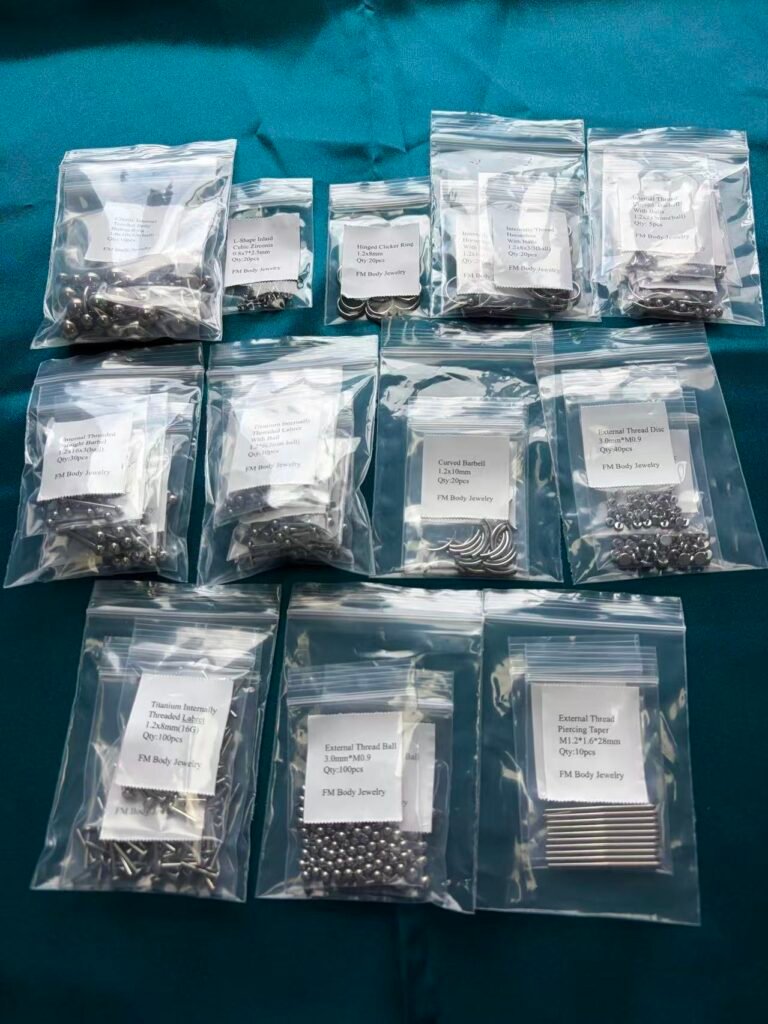
Emma was interested in many designs, including basic CZ labrets, decorative tops, clickers, nose jewelry and curved barbells.
Ordering every color and specification immediately would have increased her inventory risk.
Instead, we divided the products into two groups:
| Product group | Purpose | Suggested approach |
|---|---|---|
| Core best sellers | Regular studio use and repeat sales | Test common sizes and colors first |
| Fashion designs | Display, seasonal and trend-based sales | Select fewer pieces across more styles |
For the initial sample order, she selected a small quantity of each model and specification.
This allowed her to evaluate:
- Material documentation
- Polishing quality
- Threading
- Stone security
- Size accuracy
- Color consistency
- Customer response
- Sales potential
The goal of a sample order is not simply to receive one attractive piece. It is to establish a repeatable quality standard for future production.
How Did the First Sample Review Change the Order Plan?
When the samples arrived, Emma did not review them only as a buyer. She evaluated them as a professional piercer.
She compared the new pieces with the jewelry already used in her studio. She tested the threaded tops with matching posts, inspected the polish under bright light and checked the specifications using measuring tools.
Three findings changed her purchasing plan.
1. Basic Designs Deserved More Inventory
The decorative designs attracted attention, but classic CZ labrets and simple titanium tops were easier to use across different piercing placements.
Emma increased the planned quantity of these core products because they were more suitable for regular restocking.
2. Thread Compatibility Simplified Inventory
Using compatible threaded tops and posts allowed her to carry more decorative options without stocking every design in every post length.
She could purchase tops and posts separately, provided that the gauge and thread specification matched.
This gave her more flexibility while reducing unnecessary inventory.
3. Specifications Needed to Be Written Down
Expressions such as “small stone,” “standard post” or “gold color” are not precise enough for repeat production.
We converted each selected item into a confirmed specification containing:
- Model number
- Material
- Gauge
- Thread size
- Bar length
- Top or stone size
- Color
- Quantity
- Packaging requirement
This confirmed order sheet became the reference for both sides.
What Should Piercing Studios Check Before Choosing a Wholesale Supplier?
A good body jewelry supplier should provide more than a price list.
Before placing a wholesale order, ask the following questions.
Material
- Is the jewelry made from ASTM F136-compliant titanium?
- Is relevant material documentation available?
- Are natural titanium, anodized colors and PVD finishes clearly distinguished?
Construction
- Is the jewelry internally threaded, externally threaded or threadless?
- What thread sizes are used?
- Are the tops compatible with the supplier’s labret posts and dermal bases?
Finishing
- Is the surface mirror polished?
- Are the edges, thread openings and stone settings inspected?
- Are finished pieces free from scratches, burrs and polishing residue?
Specifications
- What gauges, lengths and diameters are available?
- Does the supplier record specifications by SKU?
- Can the same specifications be reproduced for repeat orders?
Sampling
- Can you place a small trial order before wholesale production?
- Can different models be combined?
- Will the sample specification match the future bulk order?
Customization
- Does the manufacturer provide OEM or ODM services?
- Can it make custom tops, sizes or colors?
- Are laser logos and private-label packaging available?
Quality Control
- Are products checked during machining, polishing, assembly and final packing?
- How are defects handled?
- Can photos or videos be provided before shipment?
What Changed After Emma Found the Right Manufacturing Partner?
The biggest improvement was not simply a lower purchase price.
It was predictability.
Emma could now identify which models were suitable for regular studio use, which decorative styles were worth testing, and which specifications needed to be kept in stock.
Her next order was easier because the important details had already been confirmed:
- Material standard
- Thread specification
- Common gauges and lengths
- Stone colors and sizes
- Best-selling designs
- Packaging method
- Inspection requirements
Instead of starting every order from the beginning, she could reorder existing SKUs and add new designs gradually.
That is what a reliable titanium body jewelry manufacturer should provide: not only products, but a sourcing system that becomes easier to manage as the buyer’s business grows.
What Can Piercing Studios and Jewelry Brands Learn from Emma’s Story?
Emma’s experience offers five practical lessons.
- Do not compare price without comparing specifications.
Two products that look similar in a catalog may use different materials, threading, stone settings and finishing standards. - Ask for documentation, not only a material description.
“G23 titanium” should be supported by clear information about the applicable standard. - Test compatibility during the sample stage.
Confirm that tops, posts, rings and dermal components fit the intended system. - Build a core collection before expanding too quickly.
Best-selling basic designs usually provide more stable repeat business than a large number of untested fashion styles. - Record every specification.
A confirmed order sheet protects both the buyer and manufacturer and improves repeat-order consistency.
Looking for an ASTM F136 Titanium Body Jewelry Manufacturer?
Fashion Mate Body Jewelry has specialized in titanium piercing jewelry manufacturing since 2015.
We supply piercing studios, wholesalers, distributors, jewelry stores and body jewelry brands with:
- ASTM F136 titanium body jewelry
- Internally threaded labrets and decorative tops
- Nose studs and nose rings
- Clickers and hinged rings
- Tongue, eyebrow and navel jewelry
- Dermal tops and bases
- CZ and opal designs
- OEM and ODM development
- Laser logo engraving
- Custom packaging
- Sample and wholesale order support
You can begin with selected samples to evaluate the material, polishing, threading, dimensional accuracy and overall workmanship before moving to a larger order.
Explore our titanium body jewelry collection or view our wholesale ear piercing jewelry and wholesale nose piercing jewelry.
Ready to Start Your Own Sample Evaluation?
Send us the model numbers or screenshots of the products you are interested in, together with the preferred sizes, colors and approximate quantities.
If you are unsure which products to select, we can recommend a sample combination based on your business type:
- Piercing or tattoo studio
- Wholesaler or distributor
- Jewelry or online store
- Private-label body jewelry brand
A reliable supply partnership often begins with one small sample order—and a clear quality standard.
Connect With us
Email: sales@fmbodyjewelry.com
WhatsApp: +86 19879406478
Tiktok: https://www.tiktok.com/@fashionmate02?_r=1&_t=ZT-99RwE3wE9q2
Facebook: https://www.facebook.com/share/1Em7MbmTXV/?mibextid=wwXIfr